Our People · The Workforce Behind Every Chair : Trained · Credentialed · Hands-On

Dialysis is a machine.
It is run by people.

A dialysis network does not run on equipment. It runs on the trained, credentialed, hands-on professionals who connect the patient to the machine, manage intra-dialytic events, maintain the equipment, treat the water, and audit the work afterwards. AKC's workforce is professionally trained, formally credentialed, and continuously upskilled — the foundation on which every clinical claim AKC makes actually stands.

1,850
Coworkers
70+
nephrologistson the clinical team
750+
technicians& nurses
2011
Apex Schoolof Dialysis Technology
NABH
accreditedwhere applicable

The Premise

Professional roles. One trained discipline.

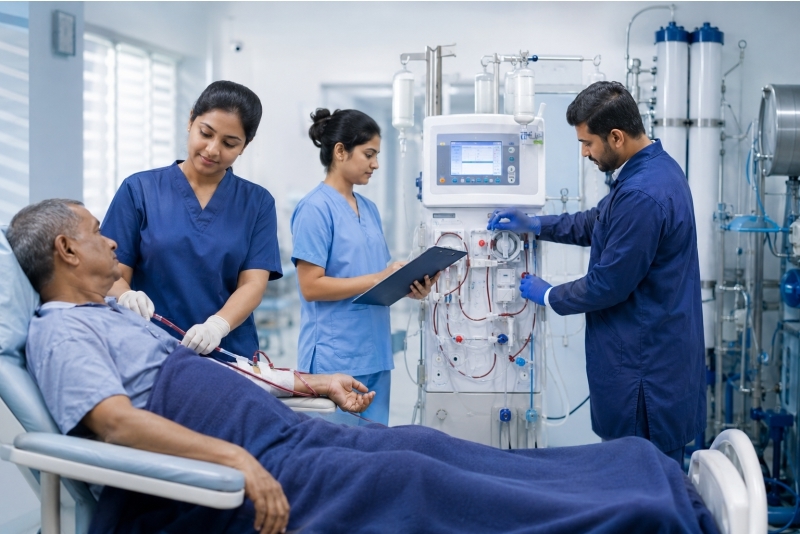
AKC clinical staff at work on a dialysis treatment floor

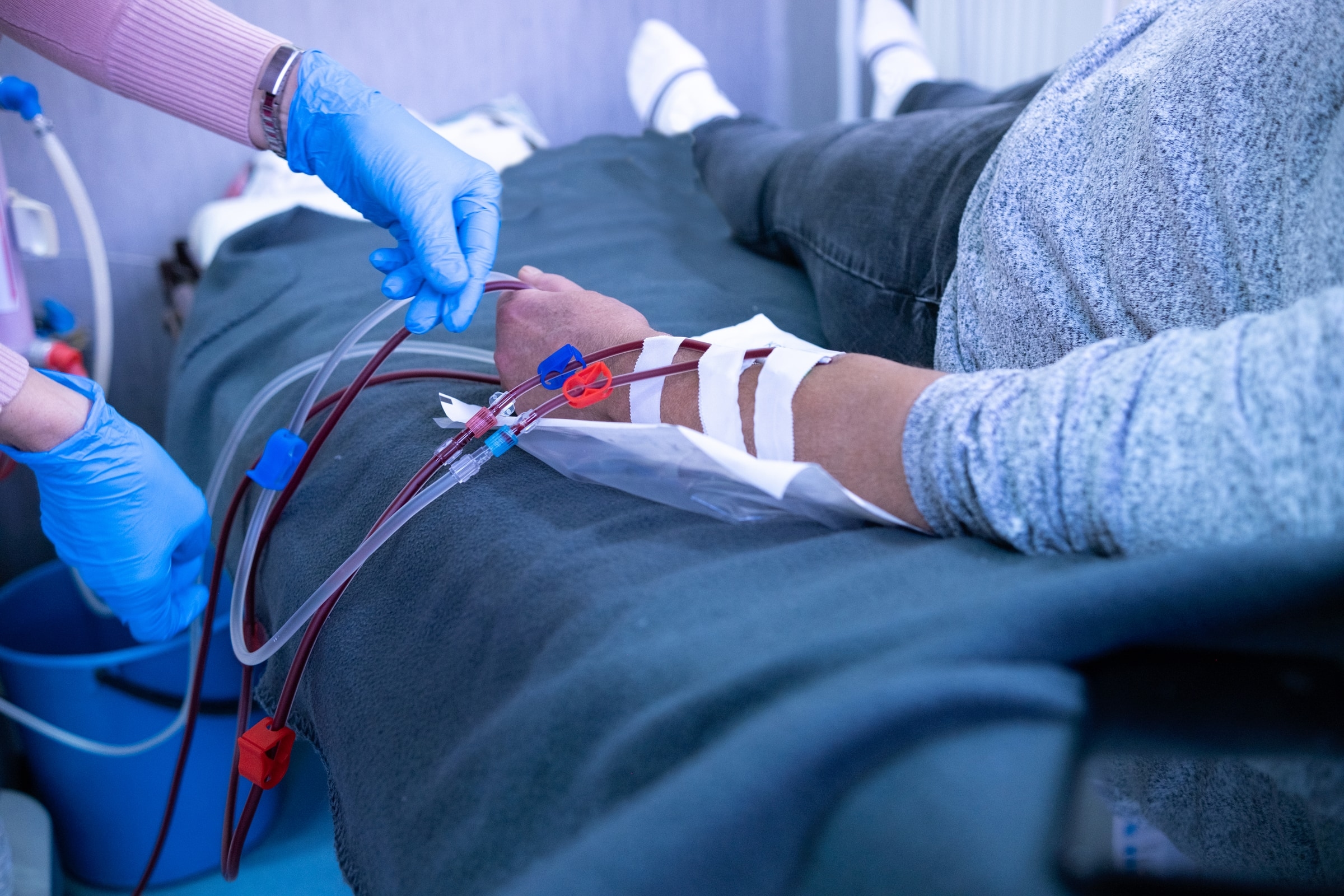
A dialysis centre runs on the coordinated work of three professionals: the dialysis technician who connects the patient to the machine and watches the session moment by moment; the dialysis nurse who manages clinical events, escalations, and medication; the biomedical engineer who keeps the dialysis machines and the RO water plant within specification.

Each role demands a specific qualification, a specific training pathway, and years of hands-on practice before a person can be fully entrusted with their part of the work. AKC treats this as a professional standard, not a hiring preference — the credentials are documented, the training is structured, and the continuous education continues throughout each professional's career on the network.

The patient does not see the years of training. They see the technician who finds the fistula on the first attempt, the nurse who responds correctly to a drop in blood pressure, the engineer who has the RO plant working before anyone notices it wasn't. That invisibility is the proof.

The Roles

The people behind every dialysis session.

Detailed profiles of the three professional roles that make a dialysis centre run — their qualifications, their training pathways, what they do during a session, and the credentials AKC requires of them.

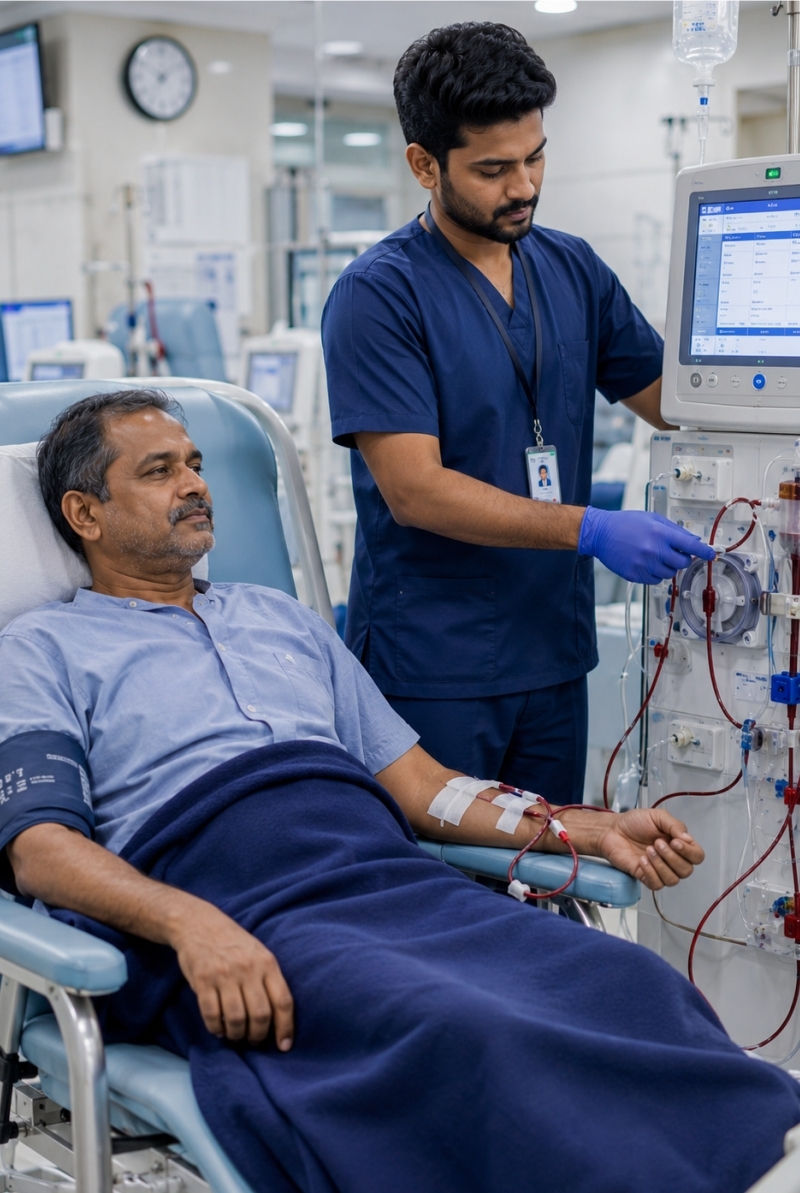
A dialysis professional at the machine beside a patient during a session
/ Role I · Photograph Region

The dialysis professional — at the machine, with the patient, throughout the session.

I

The Dialysis Professional

The person at the machine.

The dialysis professional who connects the patient to the machine, watches the session, and is the staff member the patient will see most often, year after year.

The dialysis professional is the person closest to the patient. They prepare the machine. They cannulate the vascular access. They monitor the session in real time. They respond to intra-dialytic events before they become emergencies. Over a long-tenure patient's years on dialysis, the dialysis professional is the staff member they will know best.

Qualifications

A formal credential in dialysis technology.

  • 01A graduate or diploma qualification in Dialysis Technology — typically a 2-year B.Voc, B.Sc., or recognised diploma programme.
  • 02Graduates of the Apex School of Dialysis Technology or equivalent institutions accredited under recognised university or skill-council frameworks.
  • 03Hands-on clinical training — minimum six months of supervised practice at an active dialysis centre before independent practice.
  • 04Basic Life Support (BLS) certification from the American Heart Association or equivalent, refreshed periodically.

The Standard

A dialysis professional runs the session under the directives of the nephrologist — but the patient's experience of every session is mediated by them. Their training and temperament are foundational.

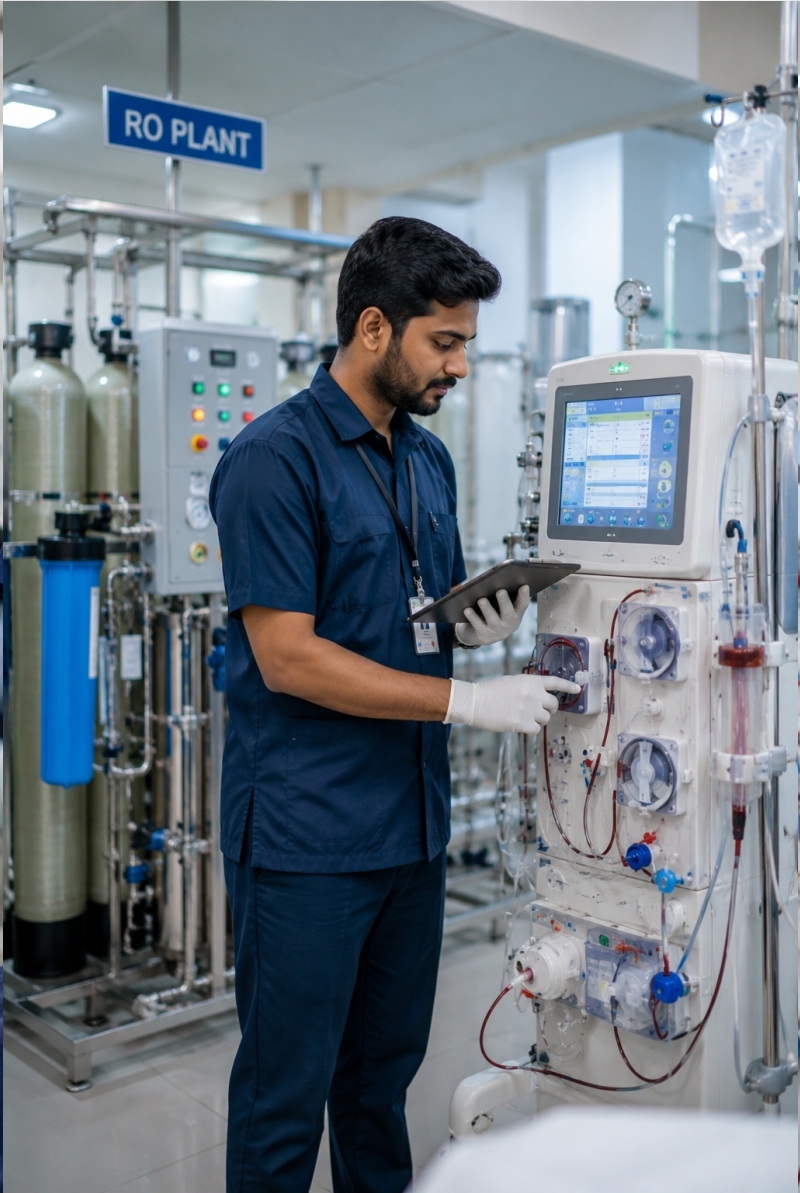
A biomedical engineer checking a dialysis machine in front of the RO water plant
/ Role II · Photograph Region

The biomedical engineer — at the RO plant and the dialysis machine, before either shows a problem.

II

The Biomedical Engineer

The professional the patient never meets.

The engineer who maintains the dialysis machines, treats and tests the water, and ensures the equipment behind every session is operating to specification.

A dialysis centre is, in the end, a hardware system. The biomedical engineer is the professional responsible for that hardware: every dialysis machine on the floor, the reverse osmosis water plant in the back, the dialysate distribution loop, the alarm systems, the sterilisation cycles, the consumables management. The patient rarely sees them — but every safe session depends on their work.

Qualifications

An engineer with medical device expertise.

  • 01A B.E., B.Tech, or Diploma in Biomedical Engineering — or a closely related engineering discipline with medical device specialisation.
  • 02Manufacturer-specific training and certifications on dialysis machines from the OEMs whose equipment is deployed in the AKC network.
  • 03Water treatment expertise — reverse osmosis system operation, AAMI/ISO water quality standards, microbiological and chemical monitoring.
  • 04Hands-on field service experience — with structured maintenance, calibration, and emergency-response protocols built into the role.

The Standard

The biomedical engineer's work is most successful when it is invisible. A patient who never thinks about whether the machine is working has been served well by an engineer doing their job correctly.

The Training Apparatus

We built the school because the country didn't have one.

In 2011, after AKC had been operating for three years, it became clear that India did not have a structured training pathway for the dialysis workforce at the scale and standard the country required. Rather than wait, AKC built one. The Apex School of Dialysis Technology has been training the network's technicians and nurses ever since, and remains one of India's most established institutions of its kind.

Founded 2011 · Apex Academia

Apex School of Dialysis Technology

A structured curriculum in dialysis technology, integrating classroom instruction with extensive hands-on training at active AKC centres. Graduates of the School form a substantial proportion of AKC's technician and nursing workforce, and many now serve at dialysis centres across India and abroad.

The School operates under the Apex Academia umbrella — AKC's institutional framework for clinical education, which also includes the ‘Dialysis Simplified’ which is the dialysis professionals annual CME programme. Curriculum, clinical training, examination, and graduation are all under one institutional standard.

Explore the School
2011
School Founded
15+
Years of Training
2 yr
Programme Length
250+
Centres for Clinical Practicum

Pathway 01

Apex School Graduates

Direct intake of Apex School of Dialysis Technology graduates — with full continuity from training to deployment within the AKC network. The single largest source of the network's technician workforce.

Pathway 02

External Institutes & Universities

Recruits from other recognised dialysis technology programmes — including university-affiliated B.Voc, B.Sc., and diploma courses from across India. Onboarded through AKC's internal credentialing and induction process.

Pathway 03

In-Network Apprenticeship

For experienced technicians joining AKC mid-career, a structured apprenticeship and recertification pathway ensures every member of the workforce meets the same standards regardless of where they trained.

Continuous Education

Training doesn't end at graduation. It continues for the career.

Dialysis is a moving field. Protocols change, equipment evolves, and the evidence base on adequacy, anaemia, and access is continuously being updated. AKC's workforce undergoes continuous structured education throughout their tenure — not as a compliance requirement, but as the working assumption of a professional clinical career.

01 · CME

Dialysis Simplified · Nephrology CME

AKC's annual continuing medical education programme for dialysis professionals, run under the Apex Academia umbrella — bringing the network's technicians and nurses together on current evidence in adequacy, anaemia, vascular access, and intra-dialytic management.

For dialysis professionals · annual

02 · In-House

Centre-Level Education Programmes

Monthly clinical updates, case reviews, and protocol training at the centre and regional level — covering adequacy, anaemia, infection control, machine handling, water quality, and evolving best practice for technicians and nurses.

For all centres · monthly

03 · Certifications

Refresher Certifications

BLS and ACLS recertification on defined cycles. Manufacturer-specific machine recertifications when equipment is updated. Periodic NABH-aligned refreshers on infection control, biomedical waste, and patient safety.

For all clinical staff · periodic

The Third-Party Validation

NABH accreditation. Audited. Documented. Earned.

Internal training and protocols are necessary. Third-party accreditation is what makes them externally verifiable. AKC pursues accreditation from the National Accreditation Board for Hospitals & Healthcare Providers (NABH) — India's official healthcare-quality accreditation body — across centres where the framework applies.
NABH Accredited

What NABH Accreditation Means

A third party comes in and audits everything.

NABH accreditation is not a self-declaration. It is a formal audit conducted by trained external assessors against a documented national standard for healthcare quality — covering clinical practice, infection control, water quality, staff credentials, documentation discipline, patient safety, biomedical waste management, and patient rights.

The figures NABH audits are the same figures the Axis QA Dashboard monitors continuously. The credentials NABH inspects are the same credentials this page describes. Accreditation is the moment the internal standard becomes externally verified.

01

Clinical Practice

Adequacy of treatment, vascular access management, anaemia and bone-mineral disease protocols, clinical documentation.

02

Infection Control

Aseptic technique, dialyser reuse protocols, viral status protocols, biomedical waste disposal, hand hygiene compliance.

03

Water Quality

RO plant operation, daily readings of TDS, endotoxin, microbiological tests, dialysate composition, AAMI/ISO standards.

04

Staff Credentials

Qualifications, training records, BLS/ACLS currency, manufacturer certifications for biomedical engineers, ongoing CME.

05

Patient Rights

Informed consent, dignity in care, grievance handling, transparency on treatment plan, family communication standards.

06

Equipment & Maintenance

Preventive maintenance schedules, calibration logs, equipment lifecycle management, alarm response protocols.

07

Documentation Discipline

Per-session records, medication administration, intra-dialytic events, audit trails, EMR completeness.

08

Emergency Preparedness

Code response protocols, fire and electrical safety, backup power, water supply contingency, emergency drills.
The Workforce

The people-scale of the network.

Behind the 250+ centres, the 1,700+ machines, and the 6.1 million dialysis sessions delivered to date stands a professional workforce of structured size and structured composition.

1,850
Total Coworkers

Across clinical, operational, technical, and administrative roles.

70+
Nephrologists

On the AKC clinical team across the national network.

750+
Dialysis Professionals

The core daily clinical workforce on the treatment floors.

BME
Biomedical Team

Dedicated engineers maintaining machines & RO plants across all centres.

The People Promise

Every dialysis session at an AKC centre is delivered and supervised by dialysis professionals, overseen by a nephrologist, and made possible by biomedical engineers the patient will never meet. That coordination is what dialysis quality actually is.

Get in touch with us