How AKC cares for dialysis patients · Public & private centres · All India
Dialysis is the treatment.The care is everything else.
Across 220+ centres in public, charitable, hospital, and private settings, AKC cares for chronic dialysis patients the same way - with scientific protocols, uncompromising safety, and the kind of human warmth that a person who comes here three times a week, for years, actually needs. This page is about how that care works in practice.
Scientific Protocols
Uncompromising Safety
Empathy by Default
Positive Daily Tone
Active Encouragement
Continuous Support
Before Anything Else
A dialysis patient is not a treatment. They are a person walking into the room this morning — with a job, a family, a fear, and a quiet hope of being treated well. How they are received in the first sixty seconds matters as much as how the next four hours are run.
Most of the work of running a dialysis network is invisible to the patient. The water purification plant. The machine calibration. The quality audits. The data infrastructure. The protocols. The training pipeline. These exist so that the patient does not have to think about them.
What the patient does experience is everything that surrounds the four hours in the chair — the way the technician says good morning. Whether anyone notices that today they look more tired than usual. Whether a question is answered in plain language or with jargon. Whether dignity is the default or an exception. That is the care.
Below is how AKC tries to do it. Six chapters of an ordinary day in the life of an AKC dialysis patient.
The Care Journey
Six chapters, told from the patient’s side.
From the first nervous walk through the door to the moment a patient gets the call about a possible transplant — the care looks different at each stage, and yet the principles are the same.
// The Arrival
The first hour of a chronic dialysis life.
Almost no one walks into a dialysis centre for the first time without fear. The patient knows the diagnosis. They have heard things. They are about to surrender four hours of their day, three days of their week, for the rest of their life as it is currently imagined. The first encounter sets the entire arc of the relationship that follows.
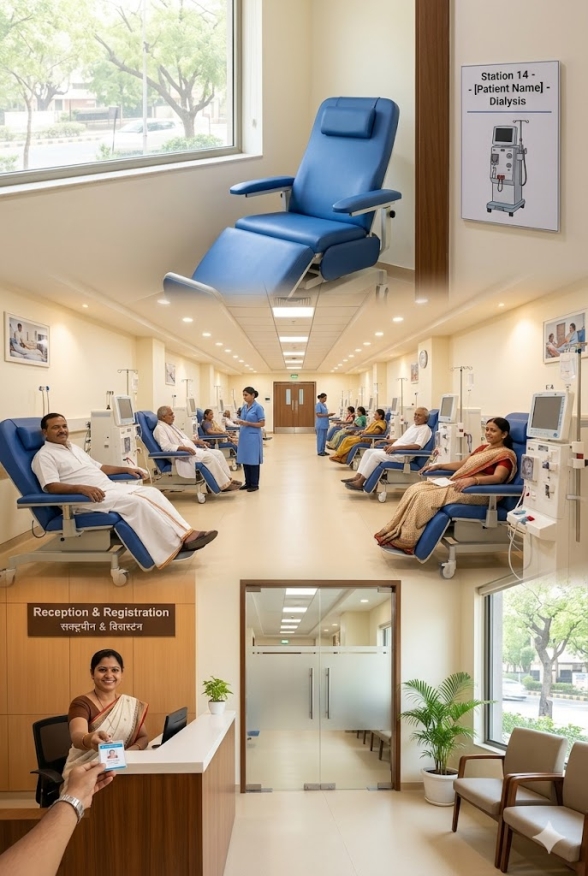
AKC’s centres are designed for this moment. A clean reception area without the chaos of a hospital corridor. A nephrologist or in-charge nurse who takes the time to explain — in plain language, in the patient’s own language — what the modality is, why it is needed, and what the next year of life will look like in concrete terms. A walk-through of the treatment floor so the patient sees the chair they will sit in, the machine they will be on, the people who will be around them.
By the time the first session begins, the patient has not been informed — they have been oriented. The difference is not semantic. It is the foundation of everything that follows.
The Care Principle
Orientation, not information. A frightened patient needs to feel the centre with their senses before they can absorb anything with their intellect.
/ Chapter I · Photograph Region
The first walk-through — the reception, the treatment floor, the chair where the patient will sit.
// The Session
Four hours, built on protocol & safety.
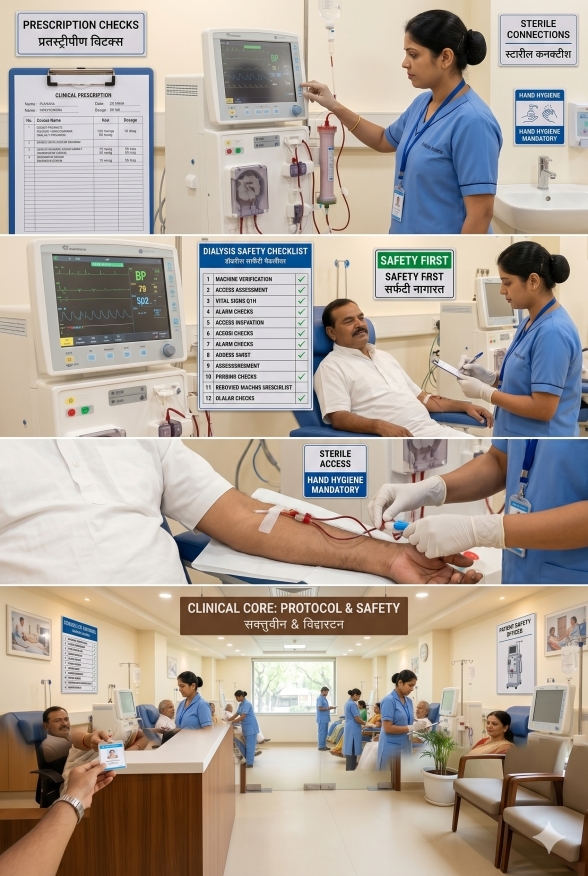
The four hours in the chair are where AKC’s clinical apparatus does its work. Pharmaceutical-grade water from the centre’s RO plant. A calibrated machine that has been serviced to schedule. A dialysate prescription matched to the patient’s weight, electrolytes, and vascular access. Every parameter logged in real time into the Axis EMR.
Safety is not an event — it is the entire architecture. Vitals are monitored continuously. Intra-dialytic events are flagged at the moment they occur, not at the end of the shift. Vascular access is examined every session for signs of recirculation, stenosis, or infection. The dialysate temperature, conductivity, blood-flow rate, and ultrafiltration target are watched against the prescription. If anything deviates, someone is in front of the machine before the patient asks.
The clinical standard is the same standard across every centre on the AKC network — Same Network Standard whether the centre is a flagship in Mumbai, a hospital unit in Hyderabad, a government PPP in rural Madhya Pradesh, or a charitable trust centre serving low-income patients. The water, the machines, the protocols, the staff training, and the QA Dashboard oversight do not differ.
The Care Principle
Scientific protocols are how empathy scales. A patient cannot be treated kindly if they are not first treated safely; safety is the precondition of every other kind of care.
/ Chapter II · Photograph Region
The session itself — machine, prescription, monitoring — the clinical core.
// The Relationship
The technician who knows the patient by name.
A chronic dialysis patient will, over years, spend more waking hours with the staff at their centre than with anyone outside their immediate family. The technician who cannulates them on Monday morning is the same one who will likely cannulate them next Monday, and the Monday after. The relationship is durable, intimate, and central to the patient’s experience of treatment.
AKC trains its dialysis workforce through the Apex School of Dialysis Technology — the country’s structured workforce pipeline AKC built in 2011 because none existed. The training is technical, but it is also explicit about relational standards: knowing the patient by name, observing changes in their condition without being asked, communicating with family members with dignity, escalating concerns up the clinical hierarchy without ego.
What this looks like in practice is small. A technician who notices that a patient has lost weight since last session and flags it for nutritional review. An in-charge nurse who remembers that a patient’s daughter is visiting from abroad this week. A nephrologist who knows that a particular patient prefers explanations drawn on paper rather than spoken. This is not service. It is care, accumulated over years.
The Care Principle
The staff is the centre. Buildings and machines are durable; people are essential. AKC’s workforce is trained to know that.
/ Chapter III · Photograph Region
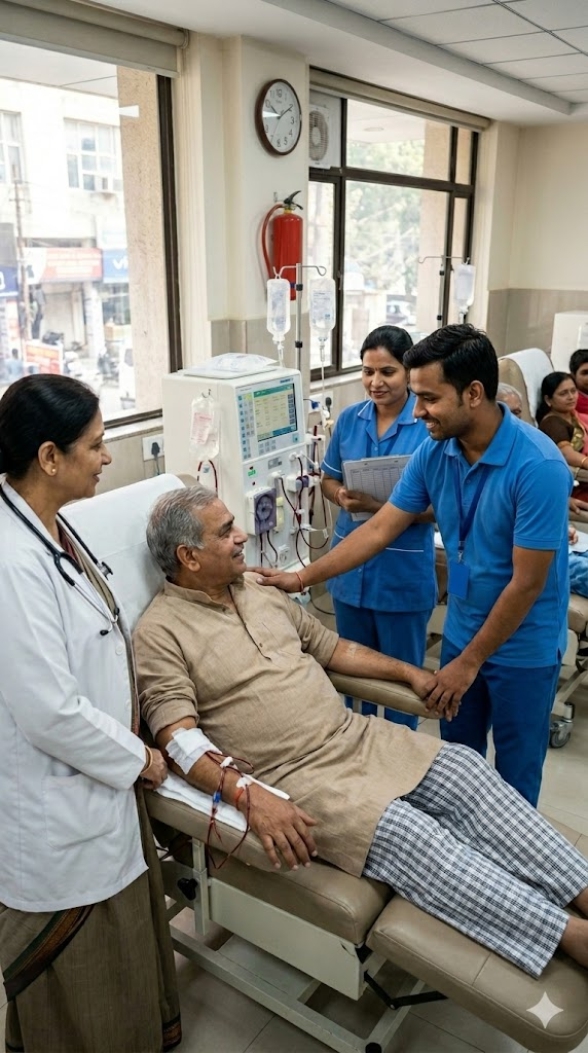
The care team — technician, nurse, nephrologist, in conversation with the patient.
// The Community
The patients who have walked this road before you.
Maintenance dialysis can be isolating. The patient often feels like the only person they know living through the constraints of the modality — the fluid restrictions, the dietary calculations, the schedule that bends every other plan around itself. The most powerful relief from this is the discovery that they are not alone.
The treatment floor of an AKC centre is, by structure, a place where patients see other patients. They notice the woman in the adjacent chair who is on her tenth year of dialysis and still works full-time. The young man across the bay who got back to playing competitive chess last year. The retired teacher who became a peer support volunteer after his own successful transplant. The long-tenure patient is the new patient’s most important teacher. AKC tries to make these connections visible.
Where appropriate, centres facilitate peer support — informal in some places, structured in others. Patient community events. Group education sessions. Family programmes for spouses, parents, and adult children. The chronic dialysis patient is treated as a member of a community, not as an isolated case.
The Care Principle
The patient is not alone. A new patient meeting a long-tenure one is often the single most encouraging moment of their first year on dialysis.
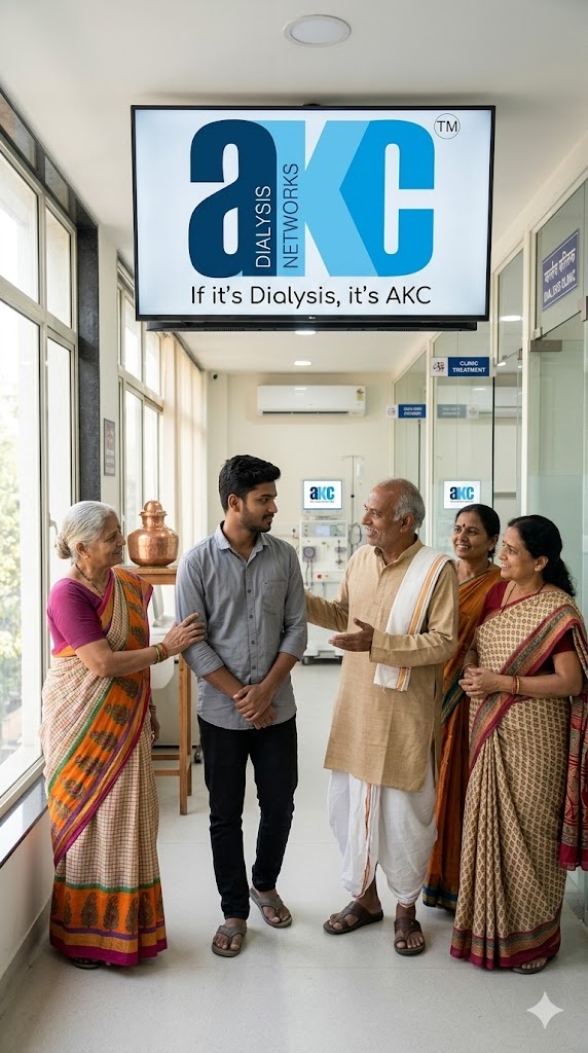
/ Chapter IV · Photograph Region
The community — patients connecting, peer support, family programmes.
// The Horizon
Dialysis is not the destination — it is the bridge.
For many patients on maintenance dialysis, a kidney transplant is the next chapter — not the final one. AKC’s clinical philosophy treats this honestly: dialysis sustains life, transplant restores it. Every patient who is medically eligible for transplantation is actively counselled about the possibility, and walked through the multiple donor pathways that exist.
This is not a polite mention in a discharge note. It is structured encouragement. The transplant conversation is initiated early. Donor evaluation pathways are explained in detail. The family is brought in. The financial, surgical, immunological, and lifestyle implications are walked through. For patients whose family donor isn’t a match, the Paired Kidney Exchange registry opens a second door. For those without a living donor at all, the waitlist is the third.
The transplant conversation is offered not because it is the cheaper option, or the more glamorous one — but because it is, for the right patient, the path back to a fuller life. AKC sees that and acts on it.
The Care Principle
Encouragement is structural, not optional. Every transplant-eligible patient deserves to know about every available pathway. Hope is a clinical intervention.
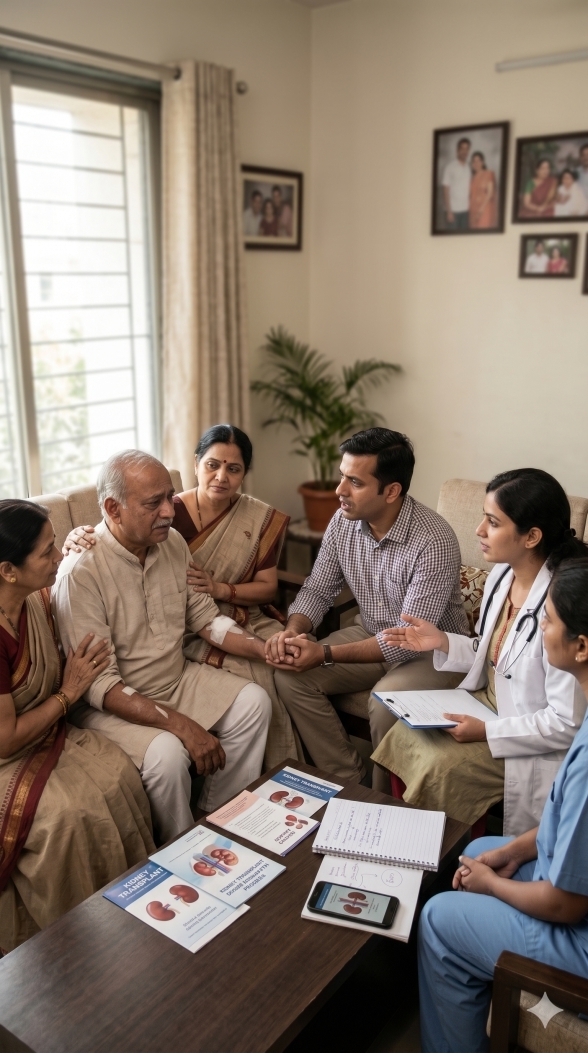
/ Chapter V · Photograph Region
The transplant conversation — family discussion, donor evaluation, the path forward.
// The Whole Person
Dialysis is one organ. The patient is a whole person.
Chronic dialysis affects every part of a person’s life — not just the kidney. Sleep is disrupted. Mood is affected. Diet becomes a daily calculation. Family relationships are recalibrated. Income may shift. Sexual health changes. Treating the kidney in isolation is treating only one part of what a person is going through.
AKC’s care therefore extends beyond the dialysis chair. Mental health support — depression rates in maintenance dialysis patients run 25–45% globally, and AKC treats this as a clinical issue rather than a quietly tolerated one. Nutritional counselling — because the dietary calculations of a CKD patient are too complex to leave to a generic dietitian. Family education — because the spouse who learns to cook for a CKD diet is doing as much clinical work as anyone in the centre.
And quiet things, too. Help navigating insurance paperwork. Help finding a vocational option that fits a three-times-a-week schedule. Help thinking through whether a particular trip abroad is feasible. The list of things a chronic dialysis patient needs is not on any standard menu — but the centre staff knows it well enough to help.
The Care Principle
The whole patient, not just the kidney. The boundaries of clinical care are drawn by what the patient actually needs — not by what fits inside a billing code.

/ Chapter VI · Photograph Region
The whole person — counselling, nutrition, family support, mental wellbeing.
The Six Promises
Made explicit. To every patient, on every visit.
The six principles that organise AKC’s care are not aspirational. They are commitments we make to every patient on every visit, in every model and every centre. Below is what each one means in practice — the lived version, not the marketing version.
// 01
Scientific Protocols
Every clinical decision is anchored to evidence-based protocols — dialysis prescription, adequacy targets, anaemia management, vascular access surveillance, infection control. AKC’s protocols are reviewed continuously, updated against international standards, and applied uniformly across all centres.
Same network · Same standard
// 02
Uncompromising Safety
NABH-grade water purity. Continuous monitoring of every machine parameter during every session. Audited service logs on every dialysis machine. Documented checks of every RO water plant, every day. Real-time event reporting. Safety is the architecture, not a feature.
Architecture · Not afterthought
// 03
Empathy by Default
Knowing the patient by name. Listening before speaking. Explaining in plain language. Acknowledging that this is hard. Empathy is what AKC trains for explicitly in its School of Dialysis Technology curriculum — treated as a clinical skill, not a personality trait.
A trained skill · Not a hope
// 04
Positive Daily Tone
The tone of a dialysis centre matters more than most clinicians admit. A patient who dreads their session does worse, clinically and psychologically, than one who arrives at ease. AKC’s centres are deliberately designed for a calm, dignified, unintimidating atmosphere — not a sterile or transactional one.
Dignity · Always the default
// 05
Active Encouragement
The transplant conversation. The peer-support introduction. The reminder that this patient ran a marathon last year. The structured belief that this person’s life is bigger than their treatment schedule. Encouragement is offered actively, not waited for — and it is offered consistently.
Hope · Is a clinical act
// 06
Continuous Support
Outside the four hours in the chair. Mental health screening and counselling. Nutritional support. Family education. Navigation of insurance, transport, schedules, and the small administrative miseries of chronic illness. AKC’s care does not end when the machine is turned off.
Beyond the chair · Always
The Care Team
With every Dailysis Machine, a team.
The care experience is created by the people who deliver it. Below are the roles around the machine — each one trained, each one accountable, each one responsible for a different dimension of the patient’s wellbeing.
// 01 · MEDICAL
The Nephrologist
Sets the dialysis prescription, reviews adequacy, manages medical complications, leads the transplant conversation, and holds clinical accountability for the patient's long-term outcome.
// 02 · DAILY CARE
The Dialysis Professional
Connects the patient to the machine, monitors the session, manages cannulation, watches for intra-dialytic events, and is the staff member the patient will see most often, year after year.
// 03 · WHOLE PERSON
The Wider Team
Dietitian, counsellor, transplant coordinator, transport liaison, family educator, peer-support volunteers. Each is a defined role with a structured contribution to the patient's care.
The Horizon · In Detail
Every transplant-eligible patient deserves to know every pathway.
For most dialysis patients, a transplant is the best clinical outcome available to them — longer survival, better quality of life, freedom from the schedule. Yet many patients in India never have the conversation, often because nobody on their care team initiated it.
AKC initiates it. Every patient who is medically eligible is offered active counselling about transplantation, walked through the donor pathways available to them, and supported through the process if they choose to pursue it. Encouragement is not ambient — it is structured into the care plan.
// Four Pathways
How AKC opens the door to transplantation.
- i
Living-Related Donor
Family-donor evaluation, immunological workup, surgical scheduling. The most direct pathway.
- ii
Paired Kidney Exchange via ASTRA
When a family donor is not a match. AKC operates one of India's most active paired-exchange registries.
- iii
Deceased Donor Waitlist
Registration support, eligibility certification, ongoing waitlist management across state and national programmes.
- iv
Fusion Pathways
AKC's research-driven model linking the waitlist and PKE registry opening additional matching possibilities.
Beyond the Chair
The care that doesn’t end when the session does.
Three dimensions of care that surround the dialysis treatment itself — each one a recognised contributor to better outcomes in maintenance dialysis, each one offered as a standard part of the AKC care model.
/ Mental Health Support
Counselling · screening · referral
// 01 · MENTAL HEALTH
A clinical issue, not a tolerated one.
Depression and anxiety in maintenance dialysis are common — published literature places prevalence rates at 25–45%. AKC’s centres treat this as a clinical issue: routine screening, accessible counselling, structured referral to mental health professionals when needed. The kidney is being treated. So is the person.
/ Nutrition
Diet plans · family education
// 02 · NUTRITION
Diet is part of the prescription.
A dialysis patient’s diet is a complex daily calculation — potassium, phosphorus, sodium, fluid, protein, all in tension with each other. AKC offers structured nutritional counselling through trained renal dietitians, with diet plans built around the patient’s actual cuisine, family arrangements, and budget — not a generic template.
/ Family Support
Education · involvement · respite
// 03 · FAMILY
The family is part of the team.
Chronic dialysis affects the whole family — spouse, parents, children, caregivers. AKC includes family in the care model: education about the modality, training on home-care between sessions, support for caregivers, and explicit recognition that the patient’s outcome depends on the family’s understanding.
The Care Promise
A dialysis patient at an AKC centre will be treated with the most rigorous clinical care we know how to deliver, and with the human warmth that the next ten years of their life will demand. Both. Always. That is the promise.